The American continental offensive
World War ZThe American continental offensive, also known as the “road to New York,” was the postwar American advance that reclaimed the United States from the living dead. Its decisive significance lay not in speed or technological superiority, but in institutional learning: after the disaster at Yonkers, the army abandoned the assumptions of conventional warfare, rebuilt itself around infantry, economical firepower, canine reconnaissance, and tightly controlled logistics, and then advanced across the continent one carefully cleared section at a time.
Strategic Necessity and a New Enemy
The offensive began against an almost unimaginable military problem. The American command estimated that two hundred million zombies remained beyond the Rocky Mountains. The scale was daunting even though the enemy was now understood more thoroughly: its origins, physiology, strengths, weaknesses, motives, and mentality had all been studied. Yet the accumulated knowledge did not make the prospect cheerful, because the living dead did not obey the limits that governed human warfare.
Human armies had to be bred, fed, and led. They required recruits, supplies, and commanders capable of issuing meaningful orders. Human populations also possessed an emotional and physiological breaking point. The living dead possessed none of these constraints. They could not be negotiated with, did not surrender, and would continue fighting until every living creature had been consumed. The offensive therefore confronted a form of total war in which the enemy’s endurance was effectively unlimited.
This reality exposed the failure of the old military culture. At Yonkers, troops had been placed on the ground behind sandbags and elaborate fighting holes, while nearby roofs and high-rise windows offered superior observation and protection. The force had prepared for small arms, artillery, and air attacks even though the coming enemy could not call in fire missions or be deterred by concealment. The result was not merely a failure of equipment or preparation. The campaign’s later doctrine recognized that the weapon that had failed was fear itself: the dead could not be shocked or awed, and their immunity to fear turned the psychological logic of conventional battle back against the living.
Rebuilding the Army
By the time of the continental advance, the American army had become almost unrecognizable. It was no longer a mechanized force built around tanks, artillery, and Bradley fighting vehicles. Those vehicles remained in reserve for the eventual recovery of cities, but the troops conducting the initial advance traveled on foot. Humvees and a small number of M-7 ASVs carried ammunition and supplies, while the infantry marched in columns across terrain that had to be reclaimed physically and continuously.
The new blue battle-dress uniform abandoned camouflage, which had little value against an enemy that did not need to identify a concealed target in the usual human way. It was light, comfortable, and woven with bite-resistant material; gloves and a hood capable of covering the entire face could be added for close urban fighting. The uniform’s practical purpose reflected the wider change in military thinking: survival depended less on looking like a conventional soldier than on resisting the distinctive physical dangers posed by the dead.
The army’s characteristic entrenching weapon was the Standard Infantry Entrenchment Tool, commonly called the “Lobotomizer” or “Lobo.” Its shovel-and-double-bladed-axe shape made it an efficient instrument for destroying a skull at close quarters. The weapon also had a psychological function for the soldiers who used it. Swinging a solid piece of steel made combat feel direct and personal, a stark contrast with the remote confidence once associated with mechanized firepower.
The primary firearm was the Standard Infantry Rifle, or SIR, a rugged semiautomatic weapon with wooden furniture, interchangeable components, and a conversion kit that allowed it to function as a long-range rifle, midrange infantry weapon, or close-combat carbine. It could be dragged through mud, left in sand, or dropped into saltwater without jamming. An approximately eight-inch folding spike provided a further emergency weapon. Its reliability mattered more than uncertain questions about whether it derived from the AK, the XM8, or a weapon first developed during the siege of the Hero City.
The SIR’s standard ammunition, Cherry PIE, was designed specifically for the dead. Its pyrotechnically initiated explosive projectile shattered inside a zombie’s skull and burned the brain with its fragments, while avoiding the dispersal of infected gray matter. This eliminated the need for wasteful bonfires and, on burial duty, made decapitation unnecessary: troops could dig a trench and bury the intact body after the brain had been destroyed.
Doctrine, Formation, and Advance
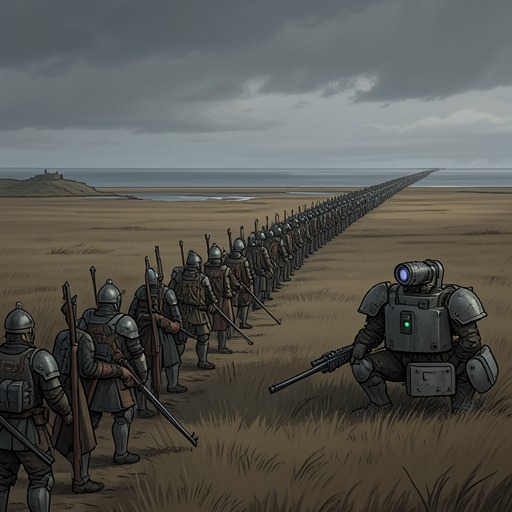
The centerpiece of the new doctrine was a two-rank firing line, with one rank active and the other in reserve. The reserve existed so that soldiers whose weapons needed recharging could step back without creating a gap in the line. In theory, the formation could keep firing continuously for as long as its ammunition lasted. This was a return to an older visual language of warfare, but it was not nostalgic imitation. The formation translated industrial limits, ammunition discipline, and the enemy’s relentless advance into a simple battlefield procedure.
The attack began with reconnaissance by K-9 units. When the dogs made contact, the troops locked and loaded, moved into position, and waited as the handlers drew hundreds of zombies toward the firing line. The dogs were then recalled behind the troops, and the army activated its Primary Enticement Mechanism. Different forces used different sounds, including bagpipes, bugles, rifle slaps, and war chants. The American force used Iron Maiden’s “The Trooper,” not to communicate with the dead but to strengthen the living. The music helped soldiers overcome dread, restore aggression, and face the approaching horde with their rifles charged.
The grand strategy divided the offensive into three Army Groups: North, Center, and South. They advanced together across the Great Plains and Midwest before separating at the Appalachians. The northern and southern wings aimed for Maine and Florida, while the center pushed over the mountains and eventually linked with the other forces along the coast. The operation took three years, a duration explained by foot transport, difficult terrain, weather, enemy contacts, and the insistence on clearing the ground rather than bypassing danger.
The army advanced in two solid lines stretching from Canada to Mexico. Whenever a zombie or a small group appeared, a Force Appropriate Response unit halted only the necessary portion of the line: a section, platoon, or company, depending on the size of the contact. Once the dead were destroyed and the battlefield sanitized, an equivalent force from the secondary line moved forward to fill the space. The leapfrogging method prevented the front from breaking while ensuring that the army did not waste the entire strength of an Army Group on a minor threat.
The procedure worked, but it was deliberately slow. Fog could immobilize the front for days, reducing combat to barking dogs, shouted warnings, weapon flashes, and indistinct shapes emerging from near-zero visibility. Winter offered no complete relief. At first, troops expected the cold to turn the campaign into a simple sanitation operation in which they would locate frozen bodies, destroy them with Lobos, and mark them for burial after the thaw. That confidence proved dangerous because the zombies were not the only threat encountered during the advance.
Logistics and Resource Discipline
The offensive depended on a military economy that could no longer draw on the productive capacity of a functioning world. In the Second World War, victory had rested on the Allies’ ability to manufacture more bullets, food, and medical supplies; secure the raw materials required for production; and transport resources to factories and finished goods to the front. During the zombie war, the surviving Americans occupied the position once associated with the Axis. The living dead controlled most of the world’s landmass, while American production relied primarily on what could be harvested in the western states.
California’s agriculture offered a possible solution to starvation, but restructuring it meant overcoming resistance from citrus growers and ranchers, especially the beef interests controlling prime farmland. The country therefore had to treat every resource as part of the military campaign. Fuel shortages had already left much of the navy idle, and the merchant fleet was crowded with refugees rather than raw materials. The offensive could not be separated from the larger effort to rebuild production, transportation, and maintenance.
This logic became formalized through the resource-to-kill ratio, developed by General Travis D’Ambrosia after he became chairman of the Joint Chiefs. The principle required commanders to judge weapons by the number of zombies they could eliminate in relation to their cost in materials, labor, fuel, and transport. It influenced confidence in the Standard Infantry Rifle and the new battle dress uniform, but it also encouraged skepticism toward spectacular projects that promised miraculous results.
Project Yellow Jacket was one such failure. Silicon Valley engineers proposed millions of micro-missiles, each roughly the size of a .22 rimfire bullet, to be scattered from transport aircraft and guided by satellites into the brains of every zombie in North America. The weapon supposedly could win the war within forty-eight hours of deployment. The project consumed resources that might have produced more practical equipment, and its failure became an enduring reminder that technical brilliance was not the same as strategic usefulness.
The Continental Airlift applied the same discipline to isolated survivor communities. It maintained contact with scattered zones, processed their requests, coordinated with the Department of Strategic Resources, and prioritized material for delivery. Its scale, in aircraft, fuel, and administration, made it the largest statistical undertaking in air force history. Self-sustaining drops of tools, spare parts, and equipment for producing spare parts took precedence over dependency drops of food and medicine, although winter still required deliveries of fish, wheat, salt, dried vegetables, and baby formula. Doctors, engineers, and Special Forces instructors were also parachuted into communities without airstrips, often knowing they would never be collected.
Consequences and Historical Meaning
The continental offensive succeeded because it converted experience into procedure. The soldiers who entered the campaign had to endure long-term Z-shock as well as physical hardship. Some collapsed, some killed themselves, and some turned their weapons on comrades. Bravery alone was insufficient; the new army required ordinary survivors who had already endured the catastrophe and could continue functioning within it.
The offensive also changed the meaning of military competence. Improvisation, once dismissed as an improvised substitute for proper equipment, became a central institutional virtue. Soldiers began discussing weapons through the language of comparative cost and effectiveness, asking why one system should be used when another could kill more zombies for the same price. The culture of resource discipline spread from planners to the rank and file, where troops devised economical tools and methods of their own.
The campaign’s great paradox is that its victory required a return to apparently primitive forms: marching infantry, straight firing lines, hand weapons, dogs, and carefully paced territorial clearance. Yet this was not a rejection of modernity. It was modernity stripped of its vanity and reorganized around the actual enemy. The army advanced slowly because it refused to leave even one inch of ground uncleared, surrounding target areas, establishing semipermanent defenses, using satellites and K-9 units to locate the dead, and entering only after it believed no further zombies were approaching.
By the time the army crossed the continent and pursued the road to New York, the offensive had become a vast act of reclamation rather than a single climactic battle. Its final achievement was institutional as much as territorial: it restored a usable relationship between weapons, resources, landscape, and human endurance. The campaign showed that the living could defeat an enemy incapable of fear only by abandoning the military habits built for fearful opponents and by making patience, economy, repetition, and collective discipline their substitute for shock and awe.